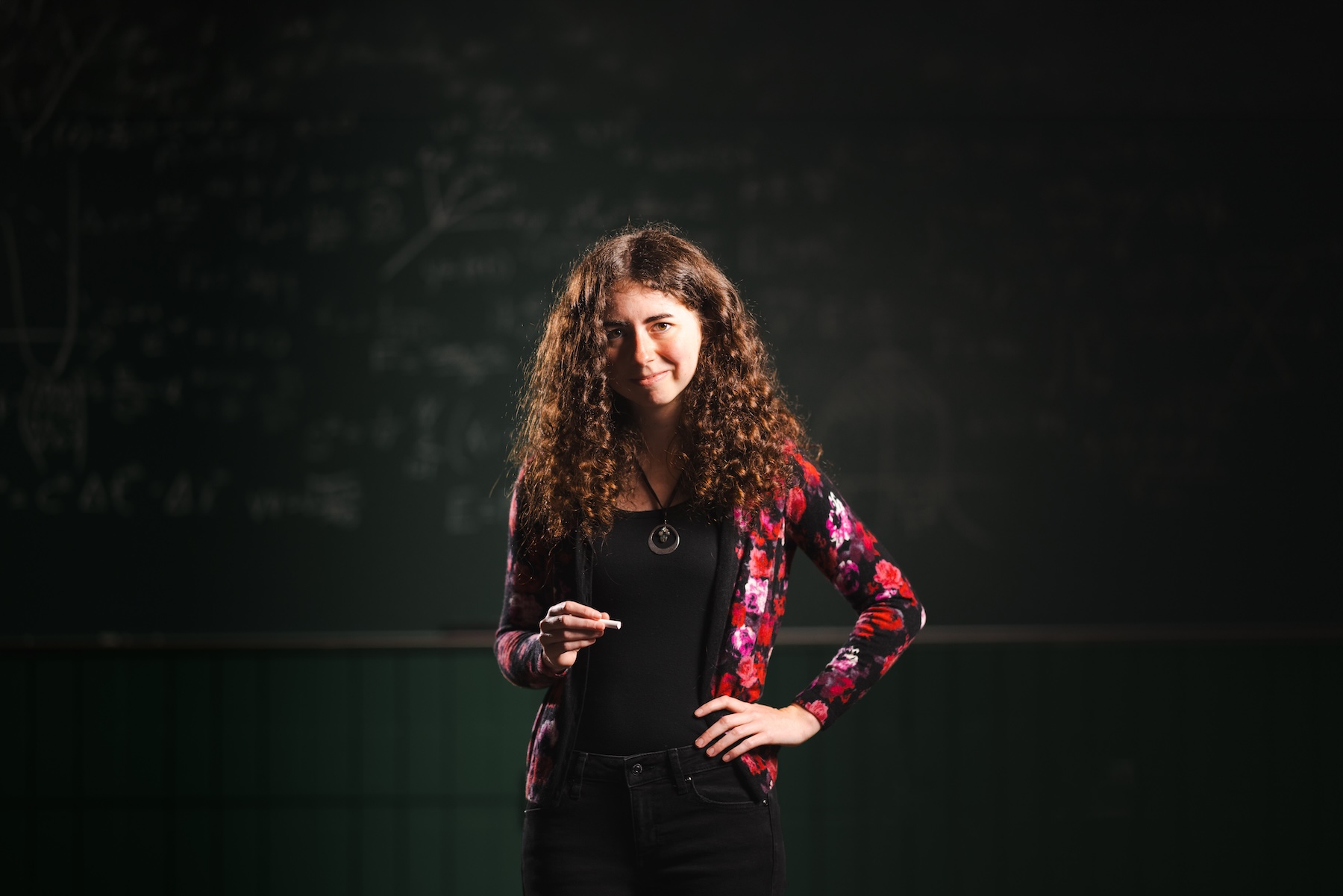
Two-time Marshall grad Ellie White plots a course to share her love of science through teaching, outreach and research.
Physics has been an ongoing adventure for two-time Marshall University graduate Ellie White.
The Barboursville, West Virginia, native who was homeschooled prior to college was exploring radio astronomy at the Green Bank Observatory even before enrolling at Marshall, and she hasn’t stopped since.
She’s snatched up opportunities to also conduct research with Marshall University’s first awarded National Science Foundation (NSF) Graduate Research Fellowship, and to serve as a NASA Solar System Ambassador, to do an internship with UC Berkeley’s SETI Research Center, for which she earned a SETI Forward Award, and complete a project with the National Radio Astronomy Observatory in Charlottesville and the University of Virginia. That project was sponsored by the NASA West Virginia Space Grant Consortium.
With researching signs of extraterrestrial intelligence as a thread through many of her endeavors, White also has given a MarshallU TEDx Talk, appeared in documentaries, offered presentations on astronomy at the Huntington Museum of Art, and advocated for the continued science- and education-focused operation of the Green Bank Observatory through her and her family’s work with the advocacy group, Go! Green Bank Observatory.
And amidst all that, she thinks she may have found a new passion — teaching. After earning her undergraduate degree in physics from Marshall in 2021, she completed her master’s degree in physics this year and found teaching to be one of the most rewarding aspects of the experience.
“It’s not an exaggeration to say that teaching that first semester was very life-changing for me,” said White, whose next step is earning her Ph.D. and continuing her NSF Fellowship research at West Virginia University. “I was fortunate to get to actually teach a lecture class as a master’s student, which was a really great opportunity. It allowed me to learn the material I was teaching really well, and I wasn’t expecting how excited students could get about astronomy.”
One thing she’s discovered — some people just love to learn about space.
“I’m always thrilled when people are excited to learn about space or astronomy,” she said. “The events at the museum have been well attended, and astronomy classes are usually full, too. I think people just really like space, and that makes me happy.”
“
It’s not an exaggeration to say that teaching that first semester was very life-changing for me.
Ellie White
A Seed Planted Early
Her love of studying the cosmos started at about 13.
“I started watching Carl Sagan’s ‘Cosmos’ and reading books and watching documentaries about space and astronomy and physics – and also paleoanthropology (I had a lot of interests. It’s an eclectic mix). It encouraged me to see how amazing science is and how it helps us connect with and understand our origins and the story of our universe in a way that’s really beautiful.”
She had originally wanted to be an artist.
“When I started to learn about astronomy, I realized this is another way to explore the universe and how beautiful it is in a way that I can see myself doing,” she said.
Being homeschooled, her parents had already been giving her plenty of opportunities to dig into her interests. They’d gone outside to watch meteor showers. Her father taught her to use their telescope.
“That seed had been planted by them and they continue to be hugely supportive — I couldn’t have done what I’ve done without them,” White said.
She also started participating in the programming offered at the Green Bank Observatory, which is home to a 100-meter telescope (the largest fully steerable telescope in the world) and is located in a National Radio Quiet Zone in rural Pocahontas County, West Virginia. Green Bank has a total of seven large radio telescopes that are used for astronomical and planetary research, satellite and spacecraft tracking, atmospheric studies, and educational programs to train the next generation of scientists and engineers.
“I’ve participated in some of their education programs, including ‘Radio Astronomer for a Day,’ which is an amazing program that any kind of student group or university can schedule there,” she said. “Then I actually started volunteering with the astrophysicists there to do some research as a high school student, and that was it. That showed me that not only did I want to do this work, but I could do it.”
The Road Back to Marshall
One big reason she chose to further her education at Marshall was the enthusiasm of the faculty and staff.
“They were super welcoming and had lots of exciting ideas for research projects that I could help with,” she said. “They were so open and full of energy and ideas, and that just really excited me.”
After graduating with her undergraduate degree, White worked for the Green Bank Observatory as a data analyst and contributed to STEAM Outreach work with the nonprofit West Virginia Alliance for STEM and the Arts (WV All STAR). White said advocacy for the Green Bank Observatory has been a passion for her and her family, with the observatory having been so significant in her educational journey and having faced funding concerns for a number of years. These learning experiences solidified her desire to further her education.
“I talked to Dr. Maria Hamilton about some research ideas, and she was open to my working on some research similar to what I had done in undergrad with the search for extraterrestrial intelligence,” White said. “She mentored me on that, and she and other faculty were very encouraging. They had a graduate assistant position available, and so that made it feasible. It was very natural for me to come back and I’m glad I did. I would not have done it any other way.”
Ellie White’s academic journey has taken her from Green Bank Observatory and Marshall University to research opportunities with NASA, UC Berkeley’s SETI Research Center and the National Science Foundation Graduate Research Fellowship.
Finding the Classroom
It was then that her experiences unearthed her love of teaching.
“I’d love to find a career that allows me to combine my love of teaching, my love of research and the ability to stay in state and do science outreach in West Virginia,”she said.
She enjoyed seeing how creative her students were when she challenged them to complete a creative project related to astronomy.
“They blew me away. It was amazing,”she said. “I had one student sew her own dress that was embellished with astronomy-related decorations. Some students did comedy skits about Galileo or things like that – and lots of beautiful poetry. They just did an amazing job, and I liked seeing their creativity and resilience. So many of them are working jobs and trying to get from one day to the next, and being able to be there with them for part of their journey was special to me and something that I hope to keep doing.”
While much of her previous research projects involved radio astronomy, her thesis project focused on optical astronomy, and involved the new Rubin Telescope with a digital camera at the NSF-DOE Vera C. Rubin Observatory in Chile. She researched with support from Hamilton and Dr. Steve Croft of UC Berkeley, Oxford University and the SETI Institute, with whom she worked during an internship.
As she heads into her Ph.D. at WVU to continue her study of physics and her NSF Fellowship research, she has a long list of people to thank, from inside and outside of Marshall, all of whom have impacted her journey. The list begins with her family— parents Deana and Daryl and brother Josh White, who provided initial and endless support, and it continues with her two graduate research advisors, Hamilton, a Marshall professor of physics, and Croft of UC Berkeley’s SETI Research Center. From Marshall, she also thanks Dr. Huong Nguyen for her guidance in physics, and Drs. Ben Eng, Brian Kinghorn, Mindy Backus and Tijah Bumgarner “for their mentorship and just being wonderful people.”
She also expressed thanks for a number of scholarships, including the A. Dixon Callihan, Donald C. Martin, and Ralph Hron Memorial Physics Scholarship provided by the Marshall University Physics Department.
Watch
Ellie White appears in The Wow Signal — the documentary on the decades-long hunt for a radio message from another civilization, the same search for extraterrestrial intelligence that runs through White’s research.
What the Cosmos Taught Her
What has she learned so far that’s worth passing on?
“One thing would be the importance of being persistent,” she said. “Some people think you have to be really smart or really good at math to study science, and I would say I’m not naturally a ‘mathy’ person. A lot of these things were very difficult for me to learn, but I think the thing that got me through it was being persistent and sticking with it and asking lots of questions.”
People often ask her what the most amazing thing she’s discovered is.
“My answer is always, ‘The most exciting thing that we know about is us — people,’” she said. “Just realizing how special we all are is important, and compassion and empathy are important.
“It can seem like the study of astronomy or space might make us feel small or insignificant, but I think it’s the opposite. As Carl Sagan said, ‘We are a way for the cosmos to know itself.’ That makes earthlings really special, and we don’t know yet that there’s anyone else out there, so for now, all we know of is us. That makes us extraordinary.”