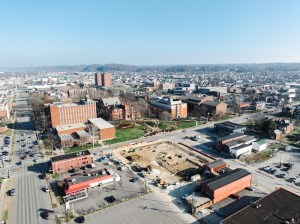
Steel beams, glass walls and possibility are reshaping Marshall University’s edges, where ambition now stretches beyond traditional campus boundaries. Along Fourth Avenue, due west of Old Main, the IDEA District is taking form as a corridor of innovation, entrepreneurship and industry partnership. On the northeast edge of campus, 75 acres are primed for future development by the city of Huntington in partnership with Marshall. Called The Foundry Center, the land includes the former ACF property, among other industrial acreage that has sat dormant for years. It will become home to a mixed-use development, including the new home of the Marshall Advanced Manufacturing Center.
These developments signal a defining moment for the university – one in which Marshall is not only expanding its physical footprint, but redefining how a public university drives workforce readiness, economic growth and student opportunity for West Virginia and beyond.
Idea District
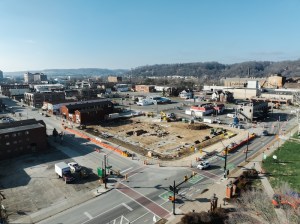
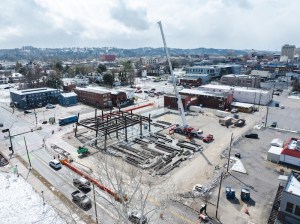
Stretching along Fourth Avenue just west of campus, redevelopment dots the landscape. The IDEA District is anchored by two major facilities that frame its parameters. On one end stands the Brad D. Smith Center for Business and Innovation, already a hub of student activity, entrepreneurial programming and industry collaboration. On the other, rising steadily from the ground, is the Institute for Cyber Security (ICS), a $45 million state-funded facility that will position Marshall as a national leader in cybersecurity research, training and workforce development.
The 73,000-square-foot ICS facility is on a fast track for completion. Construction began in November 2025. Structural steel erection is going up in the spring and passersby should see the building’s exterior being installed by early summer.
Together, these bookend facilities create an environment where academic excellence meets real-world application. Between them, companies like Intuit and Foundever have already established a presence, providing students with paid internships and professional experience without leaving the region.
But those facilities aren’t the only ones populating the IDEA District. The plans call for a three-story private office building for the old Shobe Glass property at 15th Street and Fourth Avenue. Now a staging area for construction, the land will eventually house a 60,000-square-foot building that will be home to retail and private office space and will offer modern ffice environments tailored to the needs of dynamic businesses across tech, health care, professional services and beyond. Additionally, the old Latta’s building is being retrofitted to accommodate private tenants. And eventually, a hotel and private town homes are expected to be built.
“We envision this entire area as a dynamic center of activity where people can work, attend class and enjoy the amenities of retail and dining just steps away,” said Toney Stroud, Marshall’s vice president for strategic initiatives and corporate relations. “Our partner in this project, Fairmount Properties, has had tremendous success in the higher ed arena with these types of development and we have no doubt, Marshall will be one of those successes.”
Marshall Advanced Manufacturing Center
The hum of machinery and the promise of opportunity have long defined the Marshall Advanced Manufacturing Center. Now, with a transformative $1 million gift from the Gene Haas Foundation, that promise is sharpening into something even more powerful: a new headquarters and a next-generation training environment designed to meet West Virginia’s growing manufacturing demands head-on.
The gift brings the vision of a new Marshall Advanced Manufacturing Center (MAMC) headquarters one step closer to reality and underscores Marshall University’s expanding role as a driver of workforce development and economic growth. In recognition of the contribution, MAMC will name its new 8,000-square-foot CNC machining training center the Gene Haas Advanced Machining Lab, a space that will anchor hands-on education in one of the most in-demand sectors of the modern economy.
“This gift strengthens our programs within the Marshall Advanced Manufacturing Center and serves as a catalyst for our community,” said Marshall University President Brad D. Smith. “The lab will equip students and community partners with the hands-on training that will open doors, build careers and fuel the growth of West Virginia’s manufacturing industry.”
University leaders have identified the new MAMC headquarters as a top institutional priority. Fundraising is underway for the $20 million, 55,000-square-foot facility, planned for the former ACF Industries site on Third Avenue in Huntington. When complete, the new headquarters will significantly expand MAMC’s capacity to train machinists and technicians and support manufacturers across the state and region.
The headquarters will adjoin MAMC’s Welding & Robotics Training Center, which is currently under construction at the site in the “sawtooth roof” building that formerly housed the machine shop of ACF Industries.
The Foundry Center
The Foundry Center is 75 acres of former industrial property along 23rd Street in Huntington. Stretching from Fifth Avenue to the Ohio River, the site represents one of the city’s most ambitious economic development projects in decades. Once home to heavy manufacturing operations, the corridor is being repositioned as a dynamic, mixed-use district designed to reconnect the community to its riverfront while honoring Huntington’s industrial legacy.
“Marshall University and the city of Huntington are aligned around a shared vision for growth, talent and opportunity,” said Huntington Mayor Patrick Farrell. “By working together, and alongside our county, state and federal partners, we are transforming former industrial ground into a place where students learn, businesses grow, and innovation takes root. This is how a university and a city move forward together, with purpose and with lasting impact.”
One of those businesses, Kroger, is finalizing the due diligence phase of its commitment to open a Marketplace Store, a full-service grocery store with a selection of general merchandise as well.
The Foundry Center is envisioned as a hub for advanced manufacturing, entrepreneurship, research collaboration and complementary commercial development. By leveraging Marshall’s academic and technical expertise alongside the city’s planning and economic development leadership, the initiative aims to catalyze regional growth, attract new industry and position Huntington as a competitive center for innovation along the Ohio River corridor.